


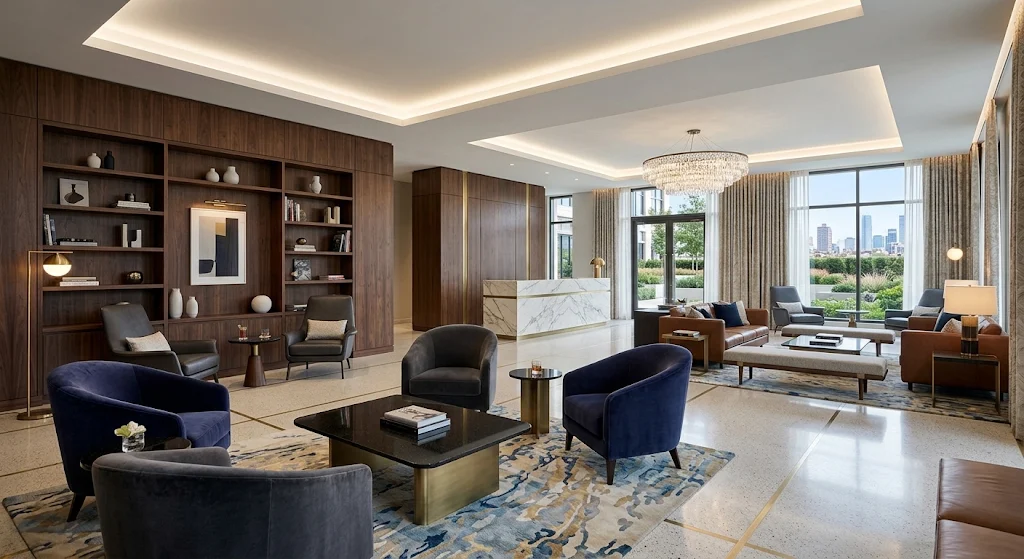
Hotel furnishings is a broader term than most buyers expect. It covers the loose and fixed furniture, the soft seating, the casegoods, the millwork, and often the decorative elements that make a room feel finished rather than fitted out. Because the scope is broad, it is also the easiest part of a project to under-budget and over-complicate. After more than 25 years supplying hotel furnishings to five-star properties, resorts, and serviced residences, we have seen the same pattern repeatedly: the furniture itself is rarely the problem, but the way it is scoped, compared, and sequenced usually is.
This article is a practical sourcing checklist rather than a design essay. It sets out what belongs in a hotel furnishings package, how to compare suppliers on equal terms, and the details that decide whether the package lands as designed or drifts into substitutions, delays, and rework.
What belongs in a hotel furnishings package
The first job is to define the boundary. Furniture, fixtures, and equipment is the wider category; hotel furnishings usually refers to the pieces that are movable or semi-fixed and that shape the guest's experience of a space. In practice that means guestroom casegoods and headboards, desks and chairs, lounge and lobby seating, dining and coffee-shop furniture, bathroom-adjacent pieces, and the millwork that turns a wall into a wardrobe or a reception desk.
Decorative items, lighting, and artwork are sometimes included and sometimes procured separately. The important thing is to state which, because a package that silently excludes them leaves a finished room looking unfinished. When we quote hotel furnishings, we mark every line as included, excluded, or by others, so the owner can see the true boundary rather than discover it at installation.
Start with the room list, not the catalogue
A common mistake is to start from a supplier's catalogue and work backwards. The stronger approach is to start from the property: how many room types, how many keys of each, which public spaces, and what each space must do. That room list becomes the spine of the package, and every piece is assigned to a location and a quantity.
A room-list-first approach exposes two things early. It shows where the same piece can be standardised across room types, which reduces cost and spare-parts complexity. And it shows where a piece must be different, because the room's proportions or the brand standard demand it. Suppliers who receive a clear room list quote more accurately; suppliers who receive a mood board quote a guess.
The categories that drive most of the cost and risk
- Guestroom casegoods: wardrobes, desks, nightstands, and dressers. High unit counts, tight tolerances, and the strongest link to the brand standard.
- Soft seating: lobby, lounge, and guestroom chairs. The category most exposed to wear and to fire-performance requirements.
- Loose furniture: dining chairs, coffee tables, side tables, and occasional pieces. Easy to under-specify because each item looks simple in isolation.
- Millwork and joinery: reception desks, wall panelling, and built-in storage. The category where site measurement errors become expensive.
- Public-area seating and tables: the highest-traffic pieces and the ones guests photograph most.
When these five are scoped together, the finish library and the hardware standard can be unified. When they are split across five vendors, every difference in timber tone or sheen becomes visible the moment the room is lit.
A sourcing checklist for hotel furnishings
| Stage | What to confirm |
|---|---|
| Scope | Room list with quantities, and every line marked included, excluded, or by others |
| Specification | Materials, finishes, hardware, and compliance standards stated in measurable terms |
| Comparison | Quotes normalised to the same spec, the same delivery terms, and the same scope |
| Prototype | A full room mock-up approved before volume, with comments documented |
| Compliance | Certificates tied to the actual materials, not to similar products |
| Logistics | Packing, freight, delivery sequence, and installation responsibility stated |
Compare suppliers on equal terms
The most frequent sourcing error is comparing quotes that are not comparable. One supplier prices solid timber, another prices veneer; one includes fire-certified foam, another leaves it as an option; one quotes ex-works, another delivered. The lowest number is often the least complete, and the gap surfaces after award.
Normalise every quote to the same specification, the same delivery terms, and the same scope before comparing. Ask each supplier to confirm the material build-up line by line, and to state what is excluded. This takes an extra day and saves weeks.
The gaps that show up at installation
Three gaps appear again and again. The first is finish mismatch between categories, usually because casegoods and joinery were made by different factories. The second is missing hardware and spare parts, because nobody ordered them as a line item. The third is a delivery sequence that does not match the site's room-block sequence, so furniture sits in corridors and blocks other trades.
All three are preventable at specification stage. Unify the finish library, add a spare-parts line, and require a delivery sequence by floor or room block. When you review hotel guestroom furniture sets, loose furniture sets, and hotel public area furniture sets, check whether they can be supplied under one finish standard rather than three.
Where owners overspend and underspend
Budget drift in hotel furnishings rarely comes from a single expensive decision. It comes from a pattern: spending on the pieces that appear in the marketing photography, and economising on the pieces that fail first. The lobby sofa is specified to a high standard because it is photographed; the guestroom desk chair is chosen from a cheaper range because nobody photographs it — and it is the chair that generates the first maintenance ticket.
The reverse also happens. Owners sometimes over-specify back-of-house or secondary spaces, paying for a finish that no guest will ever see while the public-area seating is under-built for the traffic it receives. A useful discipline is to rank every space by hours of guest contact and by cleaning intensity, then allocate the specification accordingly.
We recommend three tiers. Tier one covers the pieces guests touch and photograph most: lobby seating, restaurant chairs, guestroom beds and desks. Tier two covers secondary guest spaces where durability matters but visibility is lower. Tier three covers back-of-house and service areas, where function dominates. Mapping the package to these tiers usually frees budget for the pieces that carry the brand, without raising the total.
Frequently asked questions
Is hotel furnishings the same as FF&E?
They overlap but are not identical. FF&E is the wider category including fixtures and equipment; hotel furnishings usually refers to the movable and semi-fixed furniture pieces within it.
Should we standardise furniture across room types?
Where the brand allows, yes. Standardising reduces cost, simplifies spare parts, and makes housekeeping and maintenance more predictable.
How do we avoid finish mismatch?
Use one finish library and, where possible, one supplier for casegoods and joinery. Approve physical samples under the property's actual lighting, not in a showroom.
What is the most under-budgeted item?
Freight, installation, and spare parts. They are rarely in the headline furniture budget and always in the final cost.
How early should sourcing start?
During design development. Early supplier input on buildability and compliance prevents expensive revisions after the specification is frozen.
Should we buy hotel furnishings from one supplier or several?
One supplier is usually simpler when the scopes overlap, because the finish library and the delivery sequence stay consistent. Several suppliers can work when each covers a genuinely distinct specialty and the interfaces are clearly defined.
Hotel furnishings is a scope problem before it is a design problem. Define the boundary, build the room list, normalise the quotes, unify the finish library, and plan the delivery sequence. Do that, and the package lands as one coherent property rather than five vendors' interpretations of the same brief.
Why global hospitality teams work with OC International
OC International (OCI) has manufactured loose and fixed furniture for five-star hotels, resorts, and serviced residences since 1997. From our manufacturing base in Dongguan we support owners, developers, design firms, and FF&E consultants across the Americas, the Middle East, and Asia with one accountable team covering design development, production, quality control, packing, shipping, and on-site installation.
What our manufacturing base delivers
- In-house casegoods, soft seating, millwork and joinery under one roof — one specification, one documented quality system, one point of accountability.
- Builds engineered to the fire-safety and emissions standards your market requires — CAL 117, CAL 133, TB 133, EN 1021, BS 5852, FSC timber, and CARB P2 — under an ISO 9001-controlled production process.
- One finish library across categories, so casegoods, seating, and joinery read as one scheme.
- Coordinated logistics and installation that keep multi-room-type properties on a defined delivery sequence and a protected opening date.
Selected delivered projects
Our furniture has been delivered to landmark properties including the Fairmont Austin, Four Seasons Chicago, Sheraton Dhaka, Marriott Sydney, Conrad Los Angeles, and Hilton DoubleTree projects across multiple regions — each specified to the operator's brand standard and installed to opening.
Building a hotel furnishings package and want one finish standard across every category? Send us your room list.
Browse guestroom sets Request a scope reviewYour email address will not be published. Required fields are marked *